Admittedly, I am very new to 3D design and 3D printing. My technological skills and knowledge are still heavily on the learning track. For this reason, I am personally a lot more wary of using 3D printing in an elementary classroom.
I believe that 3D design has a spot in a grade 5 classroom, but I am not so sure about 3D printing. 3D design could be worked fairly easily into different subject areas like shapes/geometry in math, living things and cloud formation in science, and character design in language arts. Since it can be combined into other units, it is not taking any time away from other subjects but rather adding to them. It is also beneficial for students to be able to conceptualize and visualize things in 3D as it will crop up later in their schooling.
An excellent example of using 3D design across a different subject area is incorporating it into a social studies unit. Similar to the activity we did in our tech class, my L2P class worked on the spaghetti marshmallow tower challenge, but it was different because each group had a set of instructions for how they had to organize themselves. Each set of instructions depicted a different type of government – democracy, dictatorship, oligarchy, and anarchy. The kids did not know this at the time, but as they attempted to build their towers, their actions were influenced by the leadership style and at the end of the activity, this was explained to the class. I am generally not a fan of social studies, but doing an activity like this with the class gave me a new perspective on it, and I found it really useful to use the 3D design elements to broach a non-favoured subject. It also made a clear point to the students about different types of governance and what they mean. Here is a link to the lesson and activity.
When it comes to 3D printing, I believe that it is really cool to do and play with, but I do not think it is necessary in an elementary school. In elementary school, there is so much that students need to know before they move up to middle school that should take priority. When students get to high school or maybe middle school, it would be better because it can be incorporated into a computer or technology class that is more specific to the learning around it. Elementary school students are still relatively young to properly utilize and respect tools like 3D printing. Another point against 3D printing in elementary schools is simply a cost and accessibility issue. 3D printers are notoriously expensive and not something that many elementary schools would have room for in their budget. The elementary school I am in for L2P receives minimal funding as it is, which barely stretches to cover everything students need, like support aids and does not have extra money for technology tools like computers or tablets, let alone a 3D printer.
On a different note, however, learning to design and print a keychain with my name in class was super cool, and I am glad we got the opportunity to try it. I have included a picture of my design below and a video of how I created it; it is simple but still pretty cool, in my opinion.
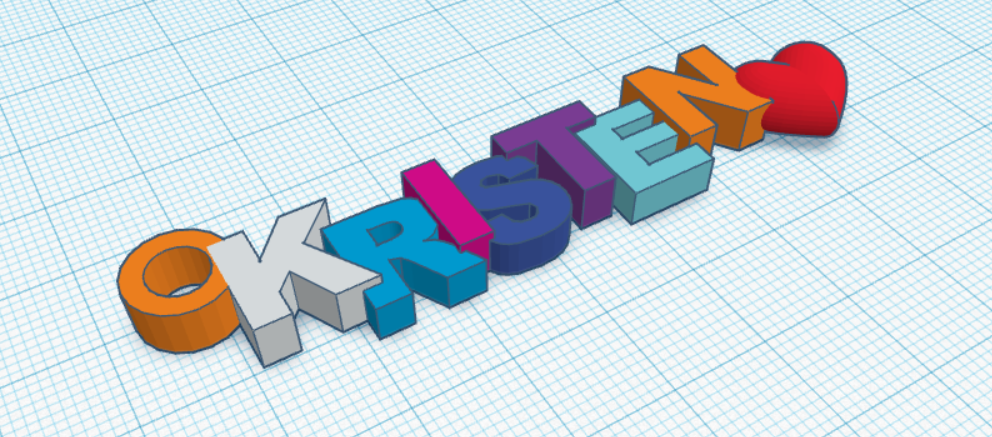
It was tricky at first because I had absolutely zero idea what I was doing, but as I continued to play around and follow a few step-by-step guided videos, it became easier and more fun. Admittedly, this could pose a challenge for someone who struggles to visualize things in 3D and can’t mentally rotate objects but that is where programs like Tinkercad can come in handy. It can help develop any 3D perception/visualization skills that may be lacking.
Catch you on the flip side,
-Kristen
Hi Kristen, I love how you talk about your experience and current skill level with technology and how you think that affects your comfort with being able to incorporate this technology in your classroom. I think your statement regarding what grade 3D design and printing should be in is very interesting, I agree that it is a difficult technology to learn and that it has a steep learning curve. Your statement that 3D printing is a great resource and something that can be used as an add-on is very insightful, and I like how you spoke about the amount of fundamental knowledge and skills that they need to learn. However, I do think that there is a place for 3D design and printing in younger classes as well as a form of exploration and creativity. To show that you do not have to be limited in your creativity. Overall I think that your reflection was very insightful and I enjoyed seeing your creation!